

Featured Articles
Three Key Factors That Define the Capability of a Mechanical Press
Three Basic Capacity Factors of a Press
"Why does production performance remain unstable even when a press has sufficient tonnage?"
This is a challenge faced by many metal stampers. In practice, selecting a press based solely on its rated tonnage often fails to provide a complete picture of its actual production capability. Therefore, when evaluating whether a mechanical press is suitable for a specific application, manufacturers should consider three critical performance factors. A comprehensive understanding of these factors helps ensure product quality, maximize production efficiency, enhance equipment reliability, and minimize the risk of premature wear on both tooling and machinery, ultimately supporting stable, long-term production.
The basic capabilities of a mechanical press can be understood through three key factors: press capacity (tonnage), transmission torque, and working energy. Together, these are the fundamentals of a press's overall processing capability.
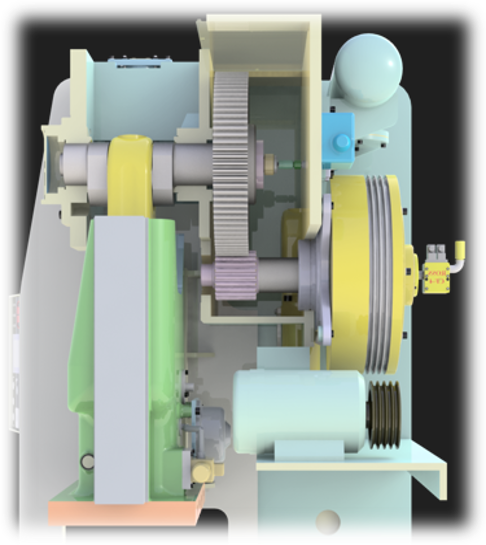 These three factors are closely related to stamping operations. If the capabilities of the press do not match the actual processing requirements, the result may be poor-quality stamped parts or production defects. More importantly, improper press operation can lead to damage to the press or die and may even pose a risk to workplace safety. Therefore, before using a press for stamping operations, it is important to have a basic understanding of these three factors.
Press Capacity (Tonnage): The Maximum Force a Press Can Safely Deliver
Press Capacity (Tonnage): Also referred to as pressing capacity or rated press force, press capacity represents the maximum pressing force that a press can safely generate. If the processing load exceeds the rated capacity, the slide connection and other components of the press may be damaged.
Overloads can occur not only when the required processing load is too high, but also due to variations in material hardness or thickness, as well as material misfeeding. Most presses are equipped with an overload protection device to help protect the machine when the processing load exceeds the rated tonnage, reducing the risk of damage to the press or die. However, to ensure long-term durability and stable operation, it is still recommended to perform stamping operations within an appropriate load range based on the actual processing application.
Tonnage Rating Point: The Position Where the Press Can Generate Its Rated Capacity
Transmission Torque: This refers to the pressing force that the punch (slide) generates at a specific position above the bottom dead center (BDC).
Due to the protective characteristics of the mechanical press mechanism, particularly the clutch, the transmission torque becomes greater as the slide position moves farther away from the Rated Tonnage Point, even when the same pressing force is applied. To protect the transmission components, the clutch limits the pressing force that can be generated at higher slide positions.
In other words, applying excessive pressing force at a position significantly above the Rated Tonnage Point increases the risk of the die becoming locked or jammed. Therefore, the required pressing force should be appropriately reduced through die design and process planning.
Conversely, as the slide approaches the Rated Tonnage Point, the available pressing force increases. In theory, the pressing force may approach an extremely high level near the bottom dead center. To prevent the processing load between the Rated Tonnage Point and the bottom dead center from exceeding the rated press capacity, mechanical presses are generally equipped with overload protection devices to help prevent damage to the press or die.
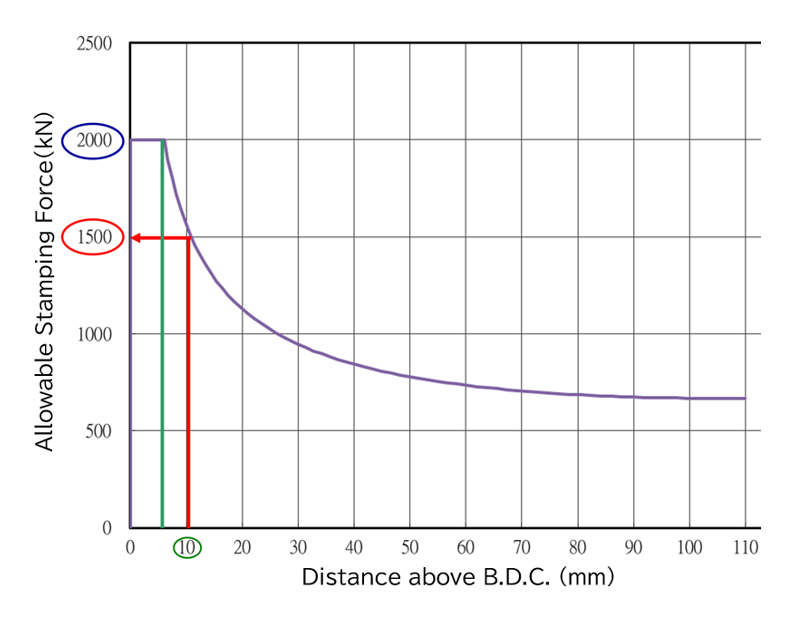 Taking the stroke-pressure curve of a 200-ton press shown above as an example, the slide can generate the press's rated capacity of 200 tons at 6 mm above bottom dead center (BDC), as indicated by the green line. This position is the Rated Tonnage Point, or the highest slide position at which the press can generate its rated capacity.
At 10 mm above BDC, the available press force is approximately 150 tons, as indicated by the red line. The stroke-pressure curve illustrates that when the processing position is above the Rated Tonnage Point, the farther the slide is from BDC, the lower the available press force becomes.
The actual capacity characteristics of a press can be found in the stroke-pressure curve provided in the press operating manual. Performing stamping operations outside the specified curve may result in damage to components such as the slide drive mechanism, transmission components, or clutch.
Working Energy: Safe Press Operation Requires the Processing Energy to Stay Within the Energy Available from the Main Motor
Working Energy: Working energy represents the amount of energy available for stamping during one press stroke.
The energy available during each stroke is primarily supplied by the flywheel, which stores rotational energy generated by the main motor. During stamping, a portion of the flywheel's stored energy is released to perform the work required for cutting, forming, or other stamping operations.
After the stamping operation, as the slide returns toward the top dead center (TDC), the main motor replenishes the energy stored in the flywheel in preparation for the next stroke.
If the energy required for the stamping operation exceeds the press's available working energy, the flywheel speed may gradually decrease. This can result in a reduction in SPM (strokes per minute) and therefore lower production output. At the same time, potentially causing overheating and, in severe cases, motor damage.
Understanding the Three Key Factors for Safe and Stable Press Operation
The three factors above are important considerations when using a mechanical press for general stamping operations. However, there are also many other factors that need to be taken into account.
The most appropriate press should be selected based on the actual processing requirements, stamping process, application, and production method. Proper equipment selection helps ensure production efficiency while supporting the safe use and stable operation of the press.
If you're evaluating a new project, experiencing production challenges, or simply looking to optimize press performance, our specialists are here to help. Contact SEYI to discuss your application and discover the solution best suited to your production goals.